The Maya calendar is a based upon a sophisticated system of days and how they relate to the moon, sun, and planet. There are many calendars that make up the Maya calendar. The “Haab” or solar calendar is made up of 260 days. The year is broken down into eighteen months and each month has twenty days with one month containing 5 days to account for the leap year. The other Maya calendar is called the Vague year and it is made up of 365 days. This is because the Maya did not account for leap days. Interlocking these two calendars is called the sacred round called the Tzolkin. The Tzolkin means ‘count of days’. This was created so that certain days could not be repeated for 52 years. During each 52-year cycle, the Vague year got 13 days out of step with the solar year, the earth’s actual 365.244 days of revolution around the sun. (Fifty-two times .2422 of an unaccounted for days equal 13.) (Libasi, 1976:11)
Unlike our current superstitions, the Maya deem the number 13 as sacred. The Maya used a counting system based on the number twenty, most likely derived from the twenty digits of the hands and feet (Marcus, 1991:26). The day names of their calendar were based on animals and natural phenomenon (e.g. earthquakes, wind, etc) and varied from group to group. The combination of a given number and day name formed a unit that could not recur until 260 days (20 x 13) had elapsed (Marcus, 1991:26).
The day names were so important to the Maya, that children were often named for the day of their birth resulting in such names as 2 Wind, 3 Crocodile, 5 Flower, 6 Monkey, and 8 Deer. The day names were given a hieroglyph, which consisted of a combination of a dot and bar. The dot stands for a single digit of one through four. The bar stands for the number five (e.g. “8 Deer would be written three dots above one bar with a picture of a deer.) Among the Maya, the number was placed to the left or above the name (Marcus, 1991:26-27).
In the ancient city of Zapotec, a monument was found dating between 2,600 and 2,500 years old. Monuments found in this city suggest that the 260-day calendar was the first used in Mesoamerica. During this discovery, the 365-day calendar was found. The 260 and 365 day calendars were used in combination to produce a cycle of dates that did not recur for a period of 52 years. This system set the stage for a more sophisticated method of reckoning time, the so called Long Count calendar. This calendar, for which the later Maya are famous for, first appeared in a series of monuments that belong in regions where the Zoque-speaking Indians lived (Marcus, 1991:26-29).
The Maya have several different languages for each of the different regions that surround the Yucatan, Belize, and El Salvador. This results in having multiple names of the month in the solar calendar of the Maya. The solar calendar is made up of eighteen months, consisting of twenty days and different glyphs representing them. Each year follows different seasons than the one before. For example, in the Yucetec language, in the Julian year A.D. 1553-1554, the Maya month Pop, the first month in the solar calendar, corresponds to July 16 to August 4. This date changes in the Julian year in A.D. 956-957, Pop is the time period between December 16 to January 4. The differences seem to revolve around the seasons of wet versus dry. The dating of the Maya calendar may have begun as far back as 550 B.C. during the middle pre-classic period and may have started during the winter season (Marcus, 1991).
The “Haab” consisted of the 18 months of 20 days plus a 5-day intercalary “month” that represented an adjustment of the Maya vigesimal system to the 365-day solar year. This 5-day month accounted for the leap year correction (Bricker, 1982:101-103). For the several languages of the Maya in the different regions of Mesoamerica, there were different names of the months. For example, Pop is the first month in the Yucatec language and Huc Uicil is the name of the first month in the Tzeltal language (Bricker, 1982:101-103).
The planet Venus to the Maya’s reckoning of time and how the calendar round was developed as a result of the Maya to calculate Venus’ synodic period. This period consisted of 584 days, which correlated with five times 584 equals 8 times 365 so that 5 correspond to a vague year. A Vague year is defined as 365 days that are not intercalated leap days. Because the Maya were in awe of time, they devised two interlocking calendars, one of 365 days and the other of 260 days, which come together every 18,980 days or 52 years (which correlated to our Julian calendar (Libasi, 1976:11-15).
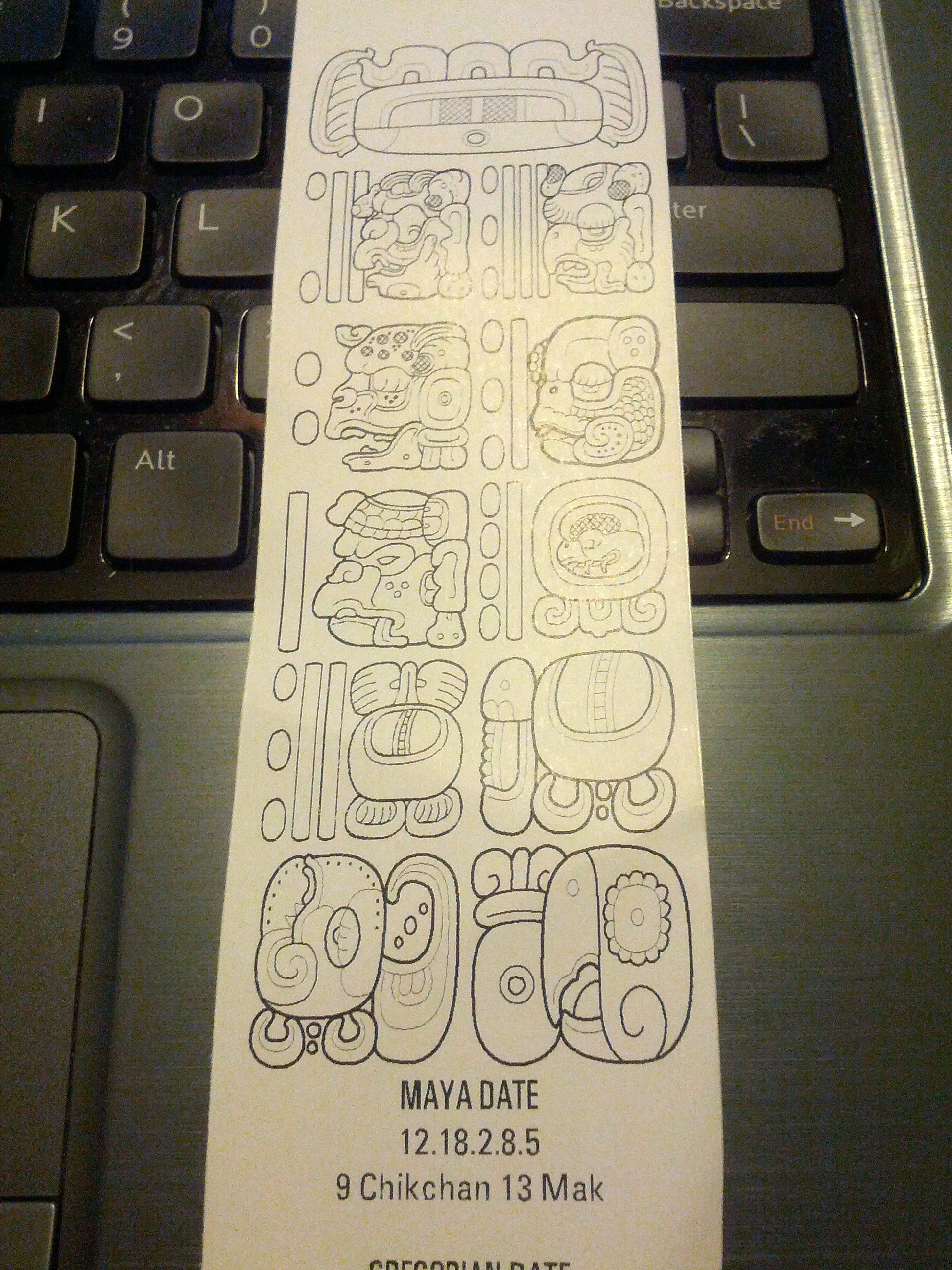
The Long Count is the most commonly used time period of all the Maya time keeping records. The start date of the long count is August 13, 3114 B.C. (Marcus, 1991:28). The Long Count has five set of numbers beginning with the largest cycle of four-hundred 360-day years (144,000 days) called Baktun, followed by the Katun, twenty 360-day years (7,200 days). The next unit, Tun, was the eighteen-month year (360-days). This was followed by the month of 20 days (Uinal) followed by the smallest unit, the Kin (Marcus, 1991, Closs 1977). Like the Haab, there were eighteen months. Because there are many languages of the Maya, so to are there different names of the months (Bricker, 1992). For all months name here in, I will be using the Yucetec language, as it is more complete than any other language. The first month of the year is Pop, the second, Uo, Zip, Zodz, Zec, Xul, Yaxkin, Mol, Ch’en, Yax, Zac, Ceh, Mac, Kankin, Muan, Pax, Cumku (also known as Uayeb) (Bricker, 1992). The string of numbers corresponds to a date in the “haab”. For example, my birthday, Dec. 23, 1975 converted to the Maya Long Count would be 12.18.2.8.7, the Tzolkin date would be 11 Manuik, and the Haab 15 Mac. The sum of these days would be 1858487 days (12 Baktun x 144,000, 18 Katuns, x 7,200 2 Tuns x 720 , 8 Uinals x 20 and 7 Kins). (Hartley, 2002).
In conclusion, the Maya was able to record time in a number of different ways. Their level of sophistication without the use of calculators, computers, and other forms of mathematical calculation is very impressive.
Bibliography:
Aveni, Anthony. “Time, Number, and History on the Maya World.”
Kronoscope 1 (2001): 29-61
Bricker, Victoria. “The Origin of Maya Solar Calendar.”
Current Anthropology. 23.1 (Feb. 1982):101-103
Libassi, Paul. “Observations Without Telescopes.”
The Sciences. (Mar/Apr. 1976): 11-15
Marcus, Joyce. “First Dates.”
Natural History. 100.4 (Apr. 1991): 26-30
 midnightdemons7
You must be logged in to post a comment.