My Thoughts on Zero Suicide as a Person with Lived Experience

My thoughts about Zero Suicide as a person with Lived Experience

There has been a lot of talk on Twitter about Zero Suicide and it’s mission to reduce the suicide rate to zero, because 1 is just too many. At first, I was appalled that clinicians think that is possible. I for one think that it is outrageous because there is always going to be someone who dies by suicide. Maybe not in their organization but outside their organization. But then I learned that it’s not an individual’s practice but an organization or health system that strives to achieve this goal. They have trainings and meeting with those in the suicidology world.

Something kept bugging me about this. I kept quiet because I didn’t want to anger those that are for it, though I think there are a few blogs that I wrote about it before I understood the mission. While talking to a friend that is a suicide loss survivor, the bells went off. She said that it goes against Shneidman’s questions, where do you hurt and how can I help?

I am a big supporter of Dr. David Jobes work with his framework called CAMS (Collaborating, Assessment, and Management of Suicidality). I don’t know if Dr. Jobes trains these Zero Suicide clinicians. And even if they are trained, I am not sure it will be used. Most clinicians have the attitude that their skills on suicide risk are good enough when it could be faulty. Worse, they go through the training yet don’t use what they are taught. That drives me up the wall. Why bother going to a training (unless it’s a mandatory thing) if you aren’t going to take away from it?

I really think CAMS is a tried and true framework to prevent suicide based on my experience of using it in my former therapy. I also used the Suicide Status Form. Unfortunately, my therapist did not want training in CAMS and we drifted apart, thus ending our relationship. We did, while we worked together, use the initial and tracking forms but unfortunately, we never got to the outcome form. She wasn’t committed enough to see it through and that kind of pissed me off. Every time I had a suicidal episode, she just wanted to know one question on the form, The one thing that would help me no longer feel suicidal. It is an open ended statement where the client fills in their thoughts on the matter. Unfortunately, I could never come up with a satisfactory answer as I really didn’t know the reason for my suicidality. I just wanted to die and that was that. I wrote a blog about CAMS if you would like more information about how it is formed and the use of the Suicide Status Form.
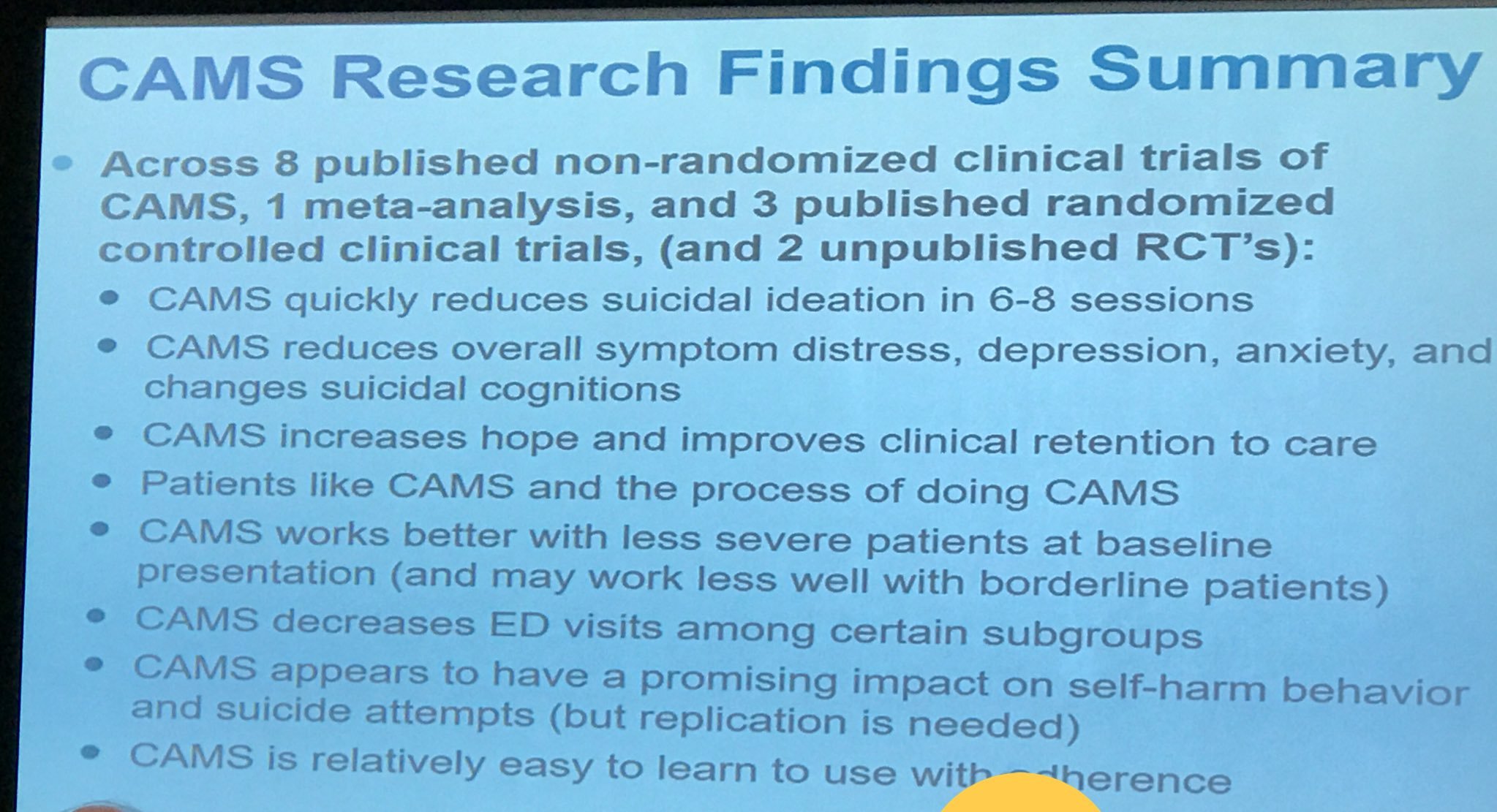
I went on the website for Zero Suicide but could not seem to find the specific training that they went through. From what I gathered on Twitter from their live tweets, some of it is CAMS and some of it is using risk factors for suicide. Unfortunately, risk factors alone are not predictive of a suicide attempt. CBT has been useful in reducing suicide attempts but not all clinicians are trained in this modality. The book by Craig Bryan on CBT for preventing suicide attempts is a good book to learn more about it. I also wrote a review on the book that you can see here.
The other thing that gets me is that no where among Zero Suicide is there talk of a person’s psychological pain. There are measures, if you look for it. Dr. Holden at Queen University in Canada has created a scale to measure what Dr. Shneidman calls psychache. See my review on the research article for more information. I think it is a good psychometric to gauge a person’s level of suicidality and pain, which ultimately leads to thoughts of suicide. This must be included in any talk of preventing or intervention of suicide and also postvention, should a suicide attempt occur.

My final thoughts of Zero Suicide is that it is a novel idea but as Dr. Shneidman says, “How many suicides do you want, and I say I don’t want any, but I want there to be the freedom to do it. I study suicide but I am not pro-suicide. I’m for suicide prevention.” I share his sentiments. I do not like the talk of “suicide is not an option”. To me, that is hindering free will. I do hope the rate of suicides goes down, but the way that health care and mental health are going, I think there will be more before it lowers, especially among the chronic pain patient population.

Chronic Pain Patients and Suicide

Chronic Pain Patients and Suicide

I was reading my tweets on Twitter. One of the chronic pain people that I follow retweeted something from a pain doctor. It was about suicides and the CDC guidelines that want to cut opioid prescriptions or limited them to only certain doctors. The article was badly editing as there were plenty of typos and I did not like the use of the word “committed” for every suicide he listed. It is sad and I know that more suicides are going to happen as the government tries to control doctors due to basically peer pressure. They have no idea what kind of havoc they are doing to those suffering from chronic pain and lead good lives because their pain is controlled.

Most of you all know I suffer from chronic pain and suicidal thoughts. My only saving grace at times is that I know after taking my meds, even though it takes a while to work, my pain will go away and be better in the morning. My suicidal thoughts will also be better when I wake up. If I no longer have my meds, I am as good as dead. There will be no point in living. I can see what all those people mentioned in the article go through. They died within weeks of being either taken off their meds or having them reduced. Some docs just stopped prescribing out of fear of losing their medical license. Some pain clinics closed their doors, leaving the patients to find other docs to just turn them down and having no where to go. This isn’t right. Taking away pain meds from patients who are not addicted and have adequate control is doing harm and causing deaths by suicide. Here is the article if you want to read it: https://medium.com/@ThomasKlineMD/here-is-a-list-of-suicides-as-of-9-9-17-caused-by-governmental-recommendations-to-educe-opioid-903c460abbc

Sometimes I think I need to end my life before my meds are taken away from me. I don’t know if my state will pressure docs to reduce their opioid prescribing privileges or number of scripts they write a year. I’m not on a lot of pain meds and I don’t abuse what I take. I take my meds in the manner they are prescribed to the letter. The sad thing is, even though my pain is somewhat managed, I still am disabled because I can’t walk that far or stand for any length of time. Just waiting for the bus or standing on the train is enough to cause me wicked bad pain at night. I remember what my pain was like when I was working. I wouldn’t be able to sleep at night and then would only have a few hours to start my next shift. It would be a really long day and then half way through my shift, I would start feeling excruciating pain that would sometimes land me in the ED. It was terrible. I know now that I will never be able to work again because my pain is just becoming unpredictable and too severe. There are some nights where all I can think about is ending my life because the pain is so severe I don’t think it’s ever going to go away or lessen. I am lucky, in a sense, that I can’t walk to where I want to die in these moments. Hell, sometimes I can’t even go to the bathroom.

Living with chronic pain is terrible and if people without a medical degree continue to dictate what a person with a medical degree does with their patients, the suicide rate is going to go up. There is no way it can go down, even with the best suicide prevention out there. There will be no stopping someone from taking their life because of untreated chronic pain. I am not talking about psychache, but I know those with chronic pain also have that too and can contribute to their suicidal thinking. I also know that if a chronic pain patient starts thinking about suicide, they should be referred to a mental health counselor or treatment center. Their pain meds should not be reduced or played with because of suicide risk. I know in my situation I was fortunate to have doctors that knew me well enough and knew that I would get help should my depression or suicidal thoughts got worse. Some patients don’t have that luxury. Always take suicidal thinking seriously. If that person owns a firearm, ask to hold it for them until their suicidal crisis is over. Make sure they get the mental health help they need. Also makes sure their pain is being properly treated or it’s not going to matter if they get that mental health help or not.

If you or someone you know is thinking of suicide please call the National Suicide Hotline at 1-800-273-8255 or text START to 741741, if in the US. Unfortunately, I don’t have access to other countries hotlines but they are available. I know Austrailia has a bunch and the UK has Samaritans 116 123 is their number off the top of my head. You matter and are important and enough, always!

Shneidman’s greatest questions: Where do you hurt and How can I help?

Shneidman’s greatest questions: Where do you hurt and How can I help?

After I had a meltdown in late 2005 and was slowly recovering in 2006, I was taking a psychometrics class at college to earn my psychology degree. Psychometrics is a fancy name for psychological testing and validating tests and assessments on various things. As I was recovering from a deep suicidal depression, I was curious to see if there were any measures on psychological pain in suicide. I wrote my first draft of the term paper with 20 some odd articles all doing various risk assessments and testing of suicide ideation but none of them dealt with psychological pain, which was what I was aiming for.

The professor tore my first draft apart and even, however vaguely, accused me of plagiarism. I wanted to get a good grade in this class because it would help my further advancement in psychology. I went back to the drawing board. I searched for pain and psychological pain in the library databank. About only 5 articles showed up, at the time. I am sure I was doing it wrong. I looked up the articles and found Shneidman and Holden. Dr. Holden was based out of Queen’s University in Canada. He came up with a psychache assessment that I found useful in my therapy. I kept that article and shared it with my therapist. Then I queried everything on Shneidman and hit the jackpot. His work was in psychache, psychological pain. I read everything I could on him and his followers. I saw my idol David Jobes’s early work on the Suicide Status Form. It wasn’t appealing to me at that time. I was more interested in the psychache of the matter.

I read Dr. Shneidman’s book, The Suicidal Mind. Holy crap! This was about “me”. I knew I had to read everything this guy wrote but it measured in the hundreds so I focused on what was available now. I tried to read his books that were solely written by him but they were few and outdated. He wrote many chapters. The two questions that I kept coming across were “where do you hurt” and “How can I help?” No one had ever asked me those questions all my years in therapy. Not even my current therapist at the time asked until I brought it up to her.

These questions were the basis of how he helped suicidal people over his career. He brought them other options for suicide by learning things about their predicament. Then he ranked them in order of importance. As he slowly worked with them, suicide became less of an option on the list, which was good. It didn’t mean their risk of attempting was any lower but they could see that it wasn’t something that had to do right then and there as there were other options. That is what suicide prevention is, finding other solutions to the problems someone is facing other than suicide. Sometimes it works, sometimes it doesn’t. There was a case in which Shneidman talked to a Hispanic male who attempted suicide by gun shot. He blew off half his face and needed multiple surgeries and was in intense pain from his injuries. Dr. Shneidman counseled this man until he was well enough to leave the hospital. They kept in touch but as time went on, the contact got fewer and fewer. The young man died by suicide by that method a few years later. It was a sad case. The importance of the story is that contact is useful even after the initial attempt has passed, be it with postcard or phone calls or text messages. This isn’t an entire protective factor but it can be. Some people who think of suicide and even go to plan it, get through their circumstances never to think about it again. Others make an attempt and it is a kind of “wake up” call and they never think about doing something like that again. Then you have the people that are chronically suicidal, who make multiple attempts. These are the people most at risk of ending their lives by their own hand. It is these people that need the most help and patience. This is where the framework CAMS (Collaborating, Assessment, and Managing Suicidality) comes in handy. Check out their website https://cams-care.com/?pgnc=1

my blogging adventures for the month

My blogging adventures for the month

In addition to my daily blah blah blogs, I will be writing about suicide prevention and about things related to it. A friend of mine gave me a few ideas on the subject as well as writing stories about what it is like being a patient in the hospital. I can go one for days with that one as I have had many hospitalizations spanning many years. I will also write some stuff on what I think works best to prevent suicide and why therapists NEED to be trained and use what they learn in their practice. Otherwise, what is the purpose of spending money or attending a seminar in suicide prevention and not use it?? That just irritates me.

I slept in three hour increments last night, giving up around 1000 or so. I washed up and shaved the back of my head to make it bald. I need to put in a new razor because it’s not as close as it should be. I’ll do that later. I then had a bowl of cereal before getting dressed and leaving to catch the bus. I brought my Bluetooth headset with me but I couldn’t get it to turn on. I think the battery died. I tried charging it while at the bus stop but couldn’t get it to work right. I put it away and pulled out my wired headset.

I dropped off the cookies I made to my barber. He loved the cookies. Then I went to Starbucks for my breakfast sandwich, espresso, and some cookies. I was able to charge my Bluetooth while there. I still have it charging on my laptop. I got kind of antsy after writing in my journal for a bit so went to CVS to look at shavers. I found one that I liked but it was $50. I made note of it on my phone and then went to catch the bus. Luckily it was late as they changed the time to 1220 not 1230 for the fall schedule. I got to the bus waiting area around 1222.

It was muggy by the time I came home. I went to Walgreens as I had a prescription to pick up and I wanted some Reese’s peanut butter cups. They had them on sale so I grabbed 2 packages. My ankle was hurting by the time I got home. I was sweating and needed to clean my sneaker off on my “good” foot as I stepped in some gum. I couldn’t wait to get to my room to cool off.

I was talking more with my friend about suicide prevention and how it’s gone to hell. She was telling me how she lost friends on Facebook because of her new adventures that are away from suicide related stuff. She had made that decision a few years ago as she felt it was time to move on to what she wanted and not live in her sister’s death by suicide. Sibling suicide survivor is hard because it really doesn’t get talked about. She was a strong voice for a while. Now it’s mostly parents that have a voice. A few brothers or sisters have come forward but it’s rare. The stigma is so great that it’s not helping the situation, even though studies have shown that sibling survivors have also thought or attempted suicide. They need care too, not just the parents.

My friend had sent me her blog that she is posting tomorrow and wanted my feedback. I was struck that she included my mentor, Dr. Shneidman’s questions, where do you hurt and how can I help? The Zero Suicide squad has gone away from that concept and really have no substance in helping preventing suicide because they really have no clue other than asking about it and how to go about asking about it, least that is my perception of it. Something about that concept was bugging me and it wasn’t until she brought about those questions that I figured out why it was bothering me so much. The sense of asking where it hurts or what is the one thing that won’t make you suicidal, or how can we make this a life worth living despite the pain of living has been lost. Some are still advocating for it but I worry that for every say 20 therapists that go through a training on suicide prevention, only 1 or 2 will actually take it to heart and use it in their practice. I will write more about this for those that care.

Shneidman was an important man in the evolution of suicidology. I think about him more during this month than any other because he advocated for suicide prevention. Stay tuned to learn more about this great man.